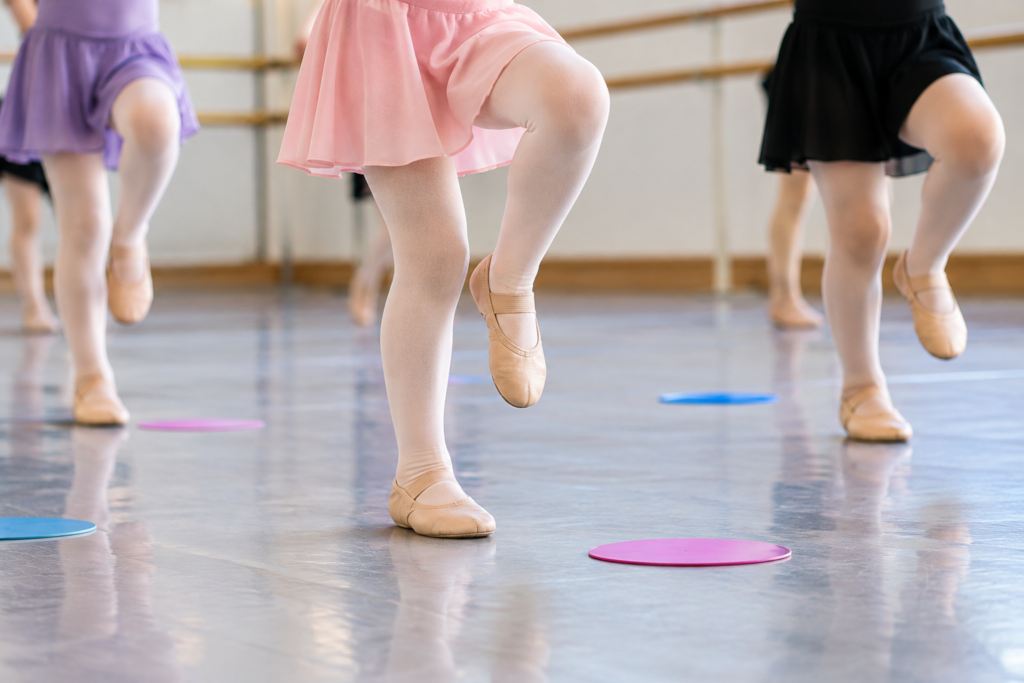
Coordination and motor skills are an important part of a child’s physical development. Children use these skills every day when they walk, run, jump, climb, write, play sport, get dressed, and complete many other everyday activities.
Dance provides children with an enjoyable way to practise and develop these skills through structured movement. During a dance class, children learn to coordinate different parts of their body, follow movement patterns, respond to music, maintain their balance, and control how quickly or slowly they move. These skills develop gradually as children grow. Regular dance classes give them opportunities to practise different movements in a supportive environment while building confidence in what their bodies can do.
Understanding Coordination and Motor Skills in Children
Coordination is the ability to use different parts of the body together smoothly and effectively. A simple movement such as jumping may require the legs, arms, core, eyes, and sense of balance to work together at the right time. Motor skills refer to the movements children make using their muscles. They are generally divided into two main areas: gross motor skills and fine motor skills. Gross motor skills involve larger muscle groups and movements such as running, jumping, balancing, turning, and skipping. Fine motor skills involve smaller and more precise movements, particularly those involving the hands and fingers.
Dance mainly supports gross motor development, but it also encourages children to develop greater control and awareness of smaller movements. Hand positions, finger placement, and detailed gestures can all require precision and concentration. By combining different movements, dance gives children regular opportunities to practise how different parts of their body work together.
How Dance Develops Gross Motor Skills
Dance involves many of the large movements children need for healthy physical development. Depending on their age and experience, students may practise walking, running, jumping, hopping, skipping, turning, stretching, and balancing. These movements require the larger muscles in the legs, hips, back, shoulders, and core. For younger children, dance classes can provide opportunities to explore basic movement patterns in a structured setting. As students become more experienced, movements can gradually become more detailed and challenging.
Common dance activities that can support gross motor development include:
- Jumping and landing with control
- Balancing on one foot
- Skipping and travelling across the floor
- Changing direction while moving
- Turning and stopping with control
- Stretching and reaching
- Moving between high and low positions
Regularly practising these movements can help children become more comfortable controlling their bodies during physical activity.
Learning to Coordinate the Arms and Legs
One of the challenges children often experience when learning dance is moving their arms and legs differently at the same time. A dance exercise might require a child to perform a particular step with their feet while holding their arms in a specific position. Later, they may need to change both positions while continuing to follow the music.
At first, children may concentrate so much on their feet that they forget what their arms should be doing. This is a normal part of learning coordination. Dance teachers generally introduce movements gradually. Students might learn the footwork first, practise the arm position separately, and then combine the two. Through repetition, children begin to understand how different movements fit together. Actions that initially require a lot of concentration can gradually become smoother and more natural.
Developing Balance and Body Control
Balance and coordination are closely connected. Children need to maintain control of their body while moving between different positions. Dance classes regularly include movements that challenge balance. Students may stand on one leg, rise onto their toes, turn, jump, or move slowly through a sequence without losing their position.
These activities encourage children to use their feet, ankles, legs, and core together. As their balance improves, children may find it easier to control more complicated movements. They can focus less on staying upright and more on coordinating the rest of the body. Dance also teaches children how to shift their weight. Understanding when and how to move weight from one foot to another is important for walking, running, turning, jumping, and many other physical activities.
Improving Motor Planning Through Dance Sequences
Motor planning is the ability to think about, organise, and complete a movement. It allows children to understand what they want their body to do and then carry out the movement in the correct order. Dance provides many opportunities to practise this skill. Students often learn short combinations made up of several movements. For example, they might take a few steps forward, turn, jump, change direction, and finish in a particular position.
To complete the sequence, children need to remember what comes next and prepare their bodies for each movement. As students progress, combinations can become longer and more detailed. This encourages them to plan their movements while also paying attention to timing, direction, posture, and other dancers. Regular practice can help children become more confident when completing multi-step physical activities.
Using Rhythm and Music to Improve Timing
Coordination is not only about moving different parts of the body. Children also need to learn when to perform each movement. Music provides a natural structure for developing timing. During dance classes, students learn to listen for beats, rhythms, and changes in tempo. They may need to begin moving at a particular moment, complete a step within a certain number of counts, or adjust their speed when the music changes.
This requires the brain and body to work together. Children listen to what is happening and then respond physically. With practice, they may become better at matching their movements to a rhythm rather than moving independently of the music. Clapping, marching, skipping, and simple movement games can introduce younger children to these concepts before they progress to more detailed dance combinations.
Developing Spatial Awareness
Children also need to coordinate their movements with the space around them. In a dance studio, students learn that movement can travel in different directions. They may move forwards, backwards, sideways, diagonally, or in a circle. They also need to understand how much space is available and where other dancers are positioned.
Dance activities can help children practise:
- Changing direction while moving
- Judging the distance between themselves and others
- Following pathways across the studio
- Staying in their position during group exercises
- Moving at different speeds
- Adjusting the size of their movements
This combination of coordination and spatial awareness helps children learn how to move safely and confidently in a shared environment.
Building Strength for Better Movement Control
Muscle strength supports coordination because children need enough stability to control their movements. Dance naturally uses many different muscle groups. The legs help children jump, bend, and travel across the floor, while the feet and ankles provide stability. The core supports posture and helps connect movements between the upper and lower body. The arms, shoulders, and back also contribute to controlled movement and positioning.
As children regularly participate in dance activities, these muscles are used in different ways. Stronger and more stable muscles can make it easier to perform movements with control. Children may gradually become more comfortable holding positions, changing direction, landing from jumps, and completing longer movement sequences.
Repetition Helps Movements Become More Natural
Learning a new physical skill usually requires repetition. A child may understand what a dance teacher is demonstrating but still need time before their body can perform the movement comfortably. Dance classes provide regular opportunities to repeat movements. A step that feels awkward during the first few attempts may gradually become easier. Once children become familiar with the basic movement, they can begin paying attention to other details such as posture, timing, arm placement, or expression.
Repetition can also help children remember movement sequences. Teachers can revisit familiar exercises while gradually adding new challenges. This allows children to build on what they already know rather than learning every movement from the beginning each week. Over time, movements that once required significant concentration may begin to feel more automatic.
Supporting Coordination Outside the Dance Studio
The coordination and motor skills children practise during dance can also be useful during other physical activities. Running, playing sport, riding a bike, using playground equipment, and participating in school activities all require children to coordinate different parts of their bodies.
Dance can also encourage children to become more aware of how they move. They learn to recognise their left and right sides, control their speed, judge distances, and respond to changes in direction. This does not mean every child will develop physical skills at the same rate. Children grow and learn differently, and some movements may take longer to master than others. Regular opportunities for movement can give children time to practise and become more comfortable with their physical abilities.
Building Confidence Through Movement
Developing coordination can also contribute to a child’s confidence during dance classes. When children first try a new movement, they may find it difficult to coordinate everything correctly. After practising several times, they may notice that the movement becomes easier. These small improvements can give children a sense of achievement.
They begin to understand that they do not need to perform a movement perfectly the first time. Instead, they can learn through listening, practising, making adjustments, and trying again. A supportive dance environment allows children to develop at their own pace while recognising their individual progress. As their movement skills improve, children may become more willing to participate in new exercises, learn longer combinations, and challenge themselves with unfamiliar movements.
Why Regular Dance Classes Can Make a Difference
Coordination and motor skills develop over time. Regular dance classes give children consistent opportunities to practise movements and gradually build on what they have learned. Weekly lessons can introduce new skills while reinforcing familiar ones. Teachers can adjust exercises according to the age and experience of their students, helping children progress without making movements unnecessarily difficult. Consistency also makes the dance environment more familiar. Children learn the class routine, understand common instructions, and become comfortable with different exercises.
This familiarity can allow them to concentrate more on developing their movement skills rather than trying to understand what is happening around them. The aim is not for every child to move in exactly the same way. Dance provides a structured and enjoyable environment where children can explore movement, develop physical skills, and become more confident in how they use their bodies.
Conclusion
Dance can help children develop coordination and motor skills through regular movement, repetition, balance, rhythm, and structured exercises. From learning how to coordinate their arms and legs to remembering movement sequences and navigating the space around them, each dance class provides opportunities to develop greater physical control. These skills can support children during dance while also helping them become more confident with everyday movement and other physical activities.
Kew School of Dance, our classes provide a supportive environment where children can develop coordination, movement skills, confidence, and a love of dance. If you would like to learn more about our classes or find the right class for your child, contact us at 03 9123 8458 or 0410 311 008.